It was a Tuesday night, sometime after eleven, when I got the message that changed how I think about this work. A woman—I’ll call her Diane—had lost her husband six hours earlier after a routine procedure went wrong. She wasn’t asking me about lawsuits. She was asking whether she had to call the hospital back tonight, because they’d already left two voicemails and she didn’t know what to say.
That’s the moment most families are actually in.
Not thinking about litigation. Just trying to breathe, trying to figure out who to call first, trying to understand why the hospital’s risk management department is suddenly so eager to speak with them. I’ve been on both sides of that phone call—I spent years in hospital risk management before I started representing families—and I know exactly why those calls go out fast. It isn’t always sinister. But the timing is never accidental. The institution is already managing its exposure, and if no one has told you that yet, I want to be the one who does.
What the First 24 Hours Actually Look Like
Before we talk about anything legal, I want to acknowledge something that doesn’t get said enough in articles like this: your body may be in shock right now. Real physiological shock. The breathlessness, the nausea, the strange calm followed by waves of something you can’t name—that’s your nervous system responding to trauma. You are not supposed to be making major decisions tonight.
The good news is, you don’t have to.
| What You Can Do Tonight | What Can Wait | What Should Never Be Rushed |
|---|---|---|
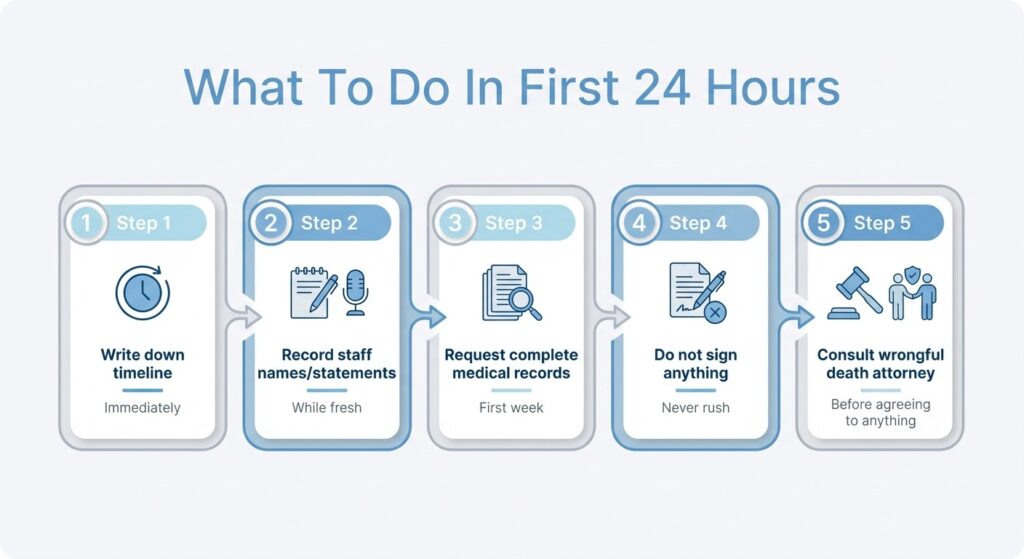
| Write down everything you remember—timeline, names, what was said | Returning calls from hospital administration or legal teams | Signing any document, especially a “release” or “acknowledgment” |
| Note staff names, titles, and any specific statements made | Responding to the insurance company | Accepting any offer without understanding what you’re giving up |
| Text or email yourself a timestamped record | Scheduling any formal meetings | Anything framed as routine paperwork from the institution |
Do this while it’s fresh, even if it’s fragmented. Notes on your phone are fine. You’re not building a case yet—you’re preserving your own memory before grief and exhaustion blur the edges.
One more thing: if you have family nearby, ask someone you trust to stay with you tonight. Not to help you make decisions. Just to be present. Grief researchers have written extensively about how isolation in the first hours of loss compounds trauma. You don’t need to process everything tonight. You just need to not be alone with it.
The Records Question
One of the most important things I tell families in the first week is this: request the medical records now, before you decide anything else.
This isn’t about assuming wrongdoing. It’s about preserving your ability to understand what happened.
Medical records—nursing notes, physician orders, medication logs, monitoring data—tell a story that verbal explanations from hospital staff often don’t. And in my experience, the completeness of those records can change significantly over time. You have a legal right to your loved one’s complete medical records. In most states, the next of kin can request them directly.
How to request records properly:
- Send the request in writing—email with read receipt, or certified mail
- Keep a copy of everything you send
- Ask specifically for the complete chart: nursing notes, all physician documentation, lab results, imaging, and any internally filed incident reports
- Follow up explicitly on incident reports—hospitals are not always forthcoming about these
- Note the date you sent the request; response timelines are regulated in most states
Why does this matter to the legal process later? Because medical records are the foundation of any wrongful death claim. Gaps, alterations, or missing entries become significant evidence in themselves. The sooner you have a copy, the sooner you have a baseline that can’t be quietly revised.
Navigating Contact From the Hospital and Insurance Company
So the hospital has called. Maybe the insurance company has too. What do you actually say?
When the hospital calls: You are not obligated to speak with risk management, patient relations, or legal counsel on their timeline. It is completely appropriate to say, “I’m not in a position to have this conversation right now. I’ll be in touch when I’m ready.” If they ask you to come in for a meeting, you can decline or postpone. If they send paperwork, do not sign it without having it reviewed first.
Here’s something I’ve seen many times: what hospitals sometimes offer in these early conversations is a combination of genuine condolence and quiet information-gathering. The person on the phone may be kind. That doesn’t mean the conversation is neutral. Anything you say about your understanding of what happened, your emotional state, or your intentions can be noted and used in how the institution prepares its response.
When the insurance company calls: This applies whether it’s the hospital’s liability insurer or your own health insurer. Insurance adjusters are trained to make early contact, establish rapport, and gather statements before families have legal guidance. You are not required to give a recorded statement. You are not required to accept any offer or settlement without understanding what you’re giving up.
An early settlement offer—especially one that arrives within days of a death—is almost always lower than what a family may be entitled to. Accepting it typically closes off further claims permanently.
The single most protective thing you can do before either of these conversations is speak with a wrongful death attorney first. Not to commit to litigation. Just to understand what you’re walking into.
What Is a Wrongful Death Claim, and Do You Have One?
A wrongful death claim is a legal action brought by surviving family members when someone dies due to another party’s negligence or misconduct. In a medical context, this typically means a hospital, physician, or care team failed to meet the accepted standard of care—and that failure caused or contributed to the death.
You don’t need certainty to consult an attorney.
Most wrongful death attorneys offer free consultations, and the purpose of that first conversation isn’t to file anything. It’s to help you understand whether what happened warrants further investigation, and what your options are. Here’s what a wrongful death attorney actually does in the early stages:
- Requests and reviews the complete medical records
- Consults with independent medical experts
- Identifies whether the standard of care was breached
- Advises you on what the justice system can and cannot realistically offer
- Acts as a buffer between you and the institutions that are already managing their exposure
If you’re in Massachusetts and trying to understand whether your family has a viable claim, speaking with experienced boston wrongful death attorneys early in the process gives you the clearest picture of your options before any decisions are made.
The Statute of Limitations: The One Deadline That Cannot Be Undone
This is where I have to be direct with you.
I’ve watched families lose options not because they made a bad decision, but because they didn’t know this deadline existed. Every state has a statute of limitations for wrongful death claims—a hard legal deadline by which a lawsuit must be filed, or the right to pursue it is permanently lost.
In Massachusetts, that window is generally three years from the date of death. In other states it may be shorter. There are some exceptions, but they are narrow and not something to count on.
Three years sounds like a long time when you’re in the middle of acute grief.
It isn’t. Building a wrongful death case requires medical record review, expert consultation, investigation, and legal preparation—all of which take time. Attorneys who handle these cases typically need months to evaluate and prepare properly. Families who wait two and a half years before consulting anyone often find themselves in a compressed, high-pressure process that could have been calmer with earlier contact.
You don’t have to decide anything today. But knowing the clock exists—and roughly when it starts—is information that belongs to you right now.
A Few Questions Families Ask Me Most Often
“Do I have to talk to the hospital at all?” No. You are not legally required to speak with hospital administration, risk management, or their legal team. You can communicate in writing, through an attorney, or not at all until you’re ready.
“What if I already said something to the hospital or signed something?” Don’t panic. Speak with an attorney as soon as possible. Depending on what was signed and when, there may still be options. Early disclosure doesn’t automatically end your ability to pursue a claim.
“What if I’m not sure negligence was involved?” That uncertainty is exactly why consultations exist. You don’t need to arrive with a conclusion. An attorney and independent medical experts can help you understand whether the care your loved one received met accepted standards—that’s their job, not yours.
“Is pursuing a claim disrespectful to my loved one’s memory?” This is one of the most common things I hear, and I want to answer it plainly: no. The families I work with aren’t primarily motivated by money. They want to understand what happened. They want accountability. They want to know that what happened to their person won’t happen to someone else’s. Asking those questions is not disrespectful. It’s an act of love.
Grief Is Not a Sidebar. It’s the Center.
Everything I’ve described above is meant to protect your options.
But I want to close by saying something that doesn’t always make it into legal guides: your grief is not a problem to be managed around the legal process. It is the reason any of this matters. The justice system can sometimes deliver understanding and accountability, and sometimes it can’t—but it cannot deliver any of those things if a family signs away their rights in the first week because no one told them they had options.
So here’s what I want you to take from this, if you take nothing else.
You are allowed to ask questions. You are allowed to take a breath before you respond to anyone. You are allowed to say “I need more time” to a hospital, an insurer, and even a lawyer. No legitimate professional will pressure you otherwise. The smallest safe step you can take today is writing down what you remember and requesting those medical records in writing.
That’s it. Everything else can follow from there, at a pace that respects both your grief and your rights.
You don’t have to have it figured out tonight. You just have to protect your ability to figure it out later.